CT-HYB Impurity Solver
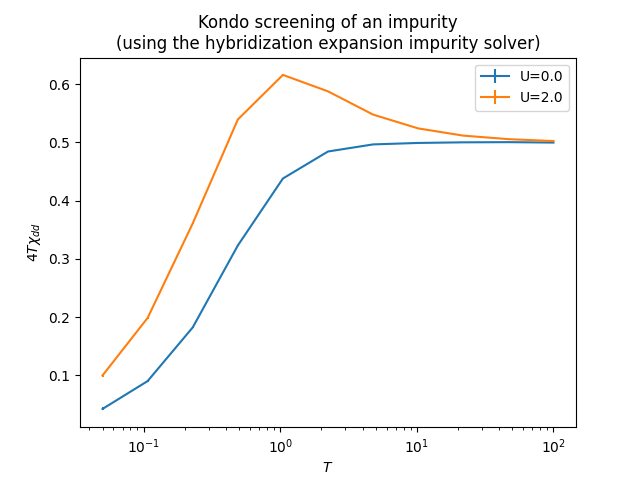
This tutorial demonstrates the continuous-time hybridization-expansion (CT-HYB) quantum Monte Carlo solver — an exact, numerically unbiased method for quantum impurity models, originally introduced by Werner et al. (Phys. Rev. Lett. 97, 076405, 2006). We simulate the Kondo effect: as temperature decreases, conduction electrons screen a magnetic impurity, progressively reducing its effective local moment. The dimensionless effective moment is , where is the local spin susceptibility. At high temperature it approaches 1/2, the value for an uncorrelated electron (a free spin would give 1); for a non-zero Coulomb interaction , it decreases toward zero at low temperature, signaling complete Kondo screening. We use a semielliptic density of states as the hybridization function — a standard choice corresponding to the Bethe lattice, commonly encountered in dynamical mean-field theory (DMFT) calculations.
Imports
from pyalps.hdf5 import archive       # HDF5 archive interface
import pyalps.cthyb as cthyb          # CT-HYB impurity solver
import matplotlib.pyplot as plt       # for plotting results
from numpy import exp, log, sqrt, pi  # math utilities
pyalps.cthyb is the hybridization-expansion solver distributed with ALPS (applications/dmft/qmc/hybridization), not the separate ALPSCore CT-HYB package.
Temperature grid
We generate 11 temperature points between and , spaced equally on a logarithmic scale to sample both the high-temperature free-spin regime and the low-temperature Kondo-screened regime:
N_T  = 11     # number of temperature points (includes both endpoints)
Tmin = 0.05   # minimum temperature
Tmax = 100.0  # maximum temperature
Tdiv = exp(log(Tmax/Tmin)/(N_T - 1))
T = Tmax
Tvalues = []
for i in range(N_T):
    Tvalues.append(T)
    T /= Tdiv
Simulation parameters
We compare two values of the on-site Coulomb interaction: (non-interacting reference) and (interacting, Kondo regime). Key parameters:
N_TAU: Number of imaginary-time grid points . Must be large enough to resolve the lowest temperature; a safe rule of thumb is .runtime: Wall-clock seconds allocated to each solver call. Increase this for production runs to improve statistical accuracy.
Uvalues = [0., 2.]  # on-site Coulomb interaction values
N_TAU   = 1000      # imaginary-time points; at least 5*BETA*U for the lowest temperature
runtime = 5         # solver runtime per temperature point (seconds)
Building the parameter list
For each combination of and , we construct a parameter dictionary:
SWEEPS: Upper bound on Monte Carlo moves. In practice,MAX_TIMEstops the solver first.THERMALIZATION: Moves discarded at the start before measurements begin (equilibration).N_MEAS: A measurement is recorded once everyN_MEASsweeps.N_ORBITALS: Number of spin-orbital flavors — here 2 for spin-up and spin-down.MU: Chemical potential. Set to to enforce particle-hole symmetry at half-filling.BETA: Inverse temperature .
values     = [[] for u in Uvalues]
errors     = [[] for u in Uvalues]
parameters = []
for un, u in enumerate(Uvalues):
    for t in Tvalues:
        parameters.append(
         {
           # solver parameters
           'SWEEPS'             : 1000000000,                          # total Monte Carlo moves (capped by MAX_TIME)
           'THERMALIZATION'     : 1000,                                # equilibration moves (discarded)
           'SEED'               : 42,                                  # random number seed
           'N_MEAS'             : 10,                                  # sweeps between measurements
           'N_ORBITALS'         : 2,                                   # spin-orbital flavors (spin-up, spin-down)
           'BASENAME'           : "hyb.param_U%.1f_BETA%.3f"%(u,1/t), # base name for the HDF5 output file
           'MAX_TIME'           : runtime,                             # wall-clock time limit per solver call (seconds)
           'VERBOSE'            : 1,                                   # print solver progress
           'TEXT_OUTPUT'        : 0,                                   # disable human-readable text output
           # file names
           'DELTA'              : "Delta_BETA%.3f.h5"%(1/t),           # hybridization function input file
           'DELTA_IN_HDF5'      : 1,                                   # read hybridization from HDF5
           # physical parameters
           'U'                  : u,                                   # on-site Coulomb repulsion
           'MU'                 : u/2.,                                # chemical potential (half-filling)
           'BETA'               : 1/t,                                 # inverse temperature
           # measurements
           'MEASURE_nnw'        : 1,                                   # density-density correlator on Matsubara frequencies
           'MEASURE_time'       : 0,                                   # disable imaginary-time measurements
           # discretization
           'N_HISTOGRAM_ORDERS' : 50,                                  # max perturbation order for histogram
           'N_TAU'              : N_TAU,                               # imaginary-time points (tau_0=0, tau_{N_TAU}=beta)
           'N_MATSUBARA'        : int(N_TAU/(2*pi)),                   # Matsubara frequency points
           'N_W'                : 1,                                   # bosonic Matsubara points for local susceptibility
           # bookkeeping
           't'                  : 1,                                   # hopping amplitude (sets energy scale)
           'Un'                 : un,                                  # index into Uvalues (for postprocessing)
         }
        )
Hybridization function
The CT-HYB solver requires the hybridization function as input, which encodes the coupling to the conduction-electron bath. We use a semielliptic density of states with half-bandwidth , and compute via a Fourier transform of the non-interacting Green’s function. The high-frequency tail is subtracted before the transform for numerical stability, then added back analytically.
for parms in parameters:
    ar = archive(parms['BASENAME']+'.out.h5', 'a')
    ar['/parameters'] = parms
    del ar
    print("Creating hybridization function...")
    g  = []
    I  = complex(0., 1.)
    mu = 0.0
    for n in range(parms['N_MATSUBARA']):
        w = (2*n+1)*pi/parms['BETA']
        g.append(2.0/(I*w + mu + I*sqrt(4*parms['t']**2 - (I*w+mu)**2)))  # semielliptic Green's function
    delta = []
    for i in range(parms['N_TAU']+1):
        tau   = i*parms['BETA']/parms['N_TAU']
        g0tau = 0.0
        for n in range(parms['N_MATSUBARA']):
            iw     = complex(0.0, (2*n+1)*pi/parms['BETA'])
            g0tau += ((g[n] - 1.0/iw)*exp(-iw*tau)).real  # Fourier transform with tail subtracted
        g0tau *= 2.0/parms['BETA']
        g0tau += -1.0/2.0                                  # add back the tail contribution
        delta.append(parms['t']**2 * g0tau)                # Delta(tau) = t^2 * G0(tau)

    ar = archive(parms['DELTA'], 'w')
    for m in range(parms['N_ORBITALS']):
        ar['/Delta_%i'%m] = delta
    del ar
Running the solver
for parms in parameters:
    cthyb.solve(parms)
Postprocessing and plotting
We extract the density-density correlator , , and at the zeroth bosonic Matsubara frequency to compute the local spin susceptibility .
for parms in parameters:
    ar      = archive(parms['BASENAME']+'.out.h5', 'a')
    nn_0_0  = ar['simulation/results/nnw_re_0_0/mean/value']
    nn_1_1  = ar['simulation/results/nnw_re_1_1/mean/value']
    nn_1_0  = ar['simulation/results/nnw_re_1_0/mean/value']
    dnn_0_0 = ar['simulation/results/nnw_re_0_0/mean/error']
    dnn_1_1 = ar['simulation/results/nnw_re_1_1/mean/error']
    dnn_1_0 = ar['simulation/results/nnw_re_1_0/mean/error']

    nn  = nn_0_0 + nn_1_1 - 2*nn_1_0
    dnn = sqrt(dnn_0_0**2 + dnn_1_1**2 + (2*dnn_1_0)**2)

    ar['chi']  = nn/4.
    ar['dchi'] = dnn/4.
    del ar

    T = 1/parms['BETA']
    values[parms['Un']].append(T*nn[0])
    errors[parms['Un']].append(T*dnn[0])

plt.figure()
plt.xlabel(r'$T$')
plt.ylabel(r'$4T\chi_{dd}$')
plt.title('Kondo screening of a magnetic impurity\n(CT-HYB hybridization-expansion solver)')
for un in range(len(Uvalues)):
    plt.errorbar(Tvalues, values[un], yerr=errors[un], label="U=%.1f"%Uvalues[un])
plt.xscale('log')
plt.legend()
plt.show()
The plot shows versus temperature on a logarithmic scale. For , the effective moment decreases proportionally to at low temperature (Pauli paramagnetism of the non-interacting limit). For , it decreases toward zero at low temperature, demonstrating the Kondo screening of the impurity spin by the conduction electrons.