MC-01b Equilibration
Every Monte Carlo simulation starts from some initial configuration — often a random or fully ordered state — that is far from equilibrium. During the first phase of the run, the Markov chain relaxes towards the equilibrium distribution, and measurements taken during this thermalization period are biased by the choice of starting point. They must be discarded before computing averages. The number of sweeps needed for the system to lose memory of its initial state is set by the autocorrelation time (see MC-01a); close to a phase transition, where correlations are long-ranged, thermalization can require many thousands of sweeps.
This tutorial covers two related diagnostics:
- Equilibration: has the simulation left its initial state and reached the equilibrium distribution?
- Convergence: has the simulation run long enough that the statistical errors in the measured averages are acceptably small?
Both are checked by inspecting the time series of a measured observable — in this case the magnetization of a 2D Ising model at its critical temperature.
Equilibration
Preparing and running the simulation on the command line
The parameter file parm1a sets up a single simulation of the Ising model on a square lattice at the critical temperature:
LATTICE="square lattice"
T=2.269186
J=1
THERMALIZATION=10000
SWEEPS=50000
UPDATE="local"
MODEL="Ising"
{L=48;}
Convert the parameter file to XML and run spinmc:
parameter2xml parm1a
spinmc --Tmin 10 --write-xml parm1a.in.xml
Preparing and running the simulation in Python
The full script is available as tutorial1a.py.
It begins by importing the required modules and defining the simulation parameters:
import pyalps
import matplotlib.pyplot as plt

parms = [{
    'LATTICE'         : "square lattice",
    'MODEL'           : "Ising",
    'L'               : 48,
    'J'               : 1.,
    'T'               : 2.269186,
    'THERMALIZATION'  : 10000,
    'SWEEPS'          : 50000,
    }]
Write the parameters to an XML input file and run spinmc:
input_file = pyalps.writeInputFiles('parm1a', parms)
pyalps.runApplication('spinmc', input_file, Tmin=10, writexml=True)
Inspecting the time series
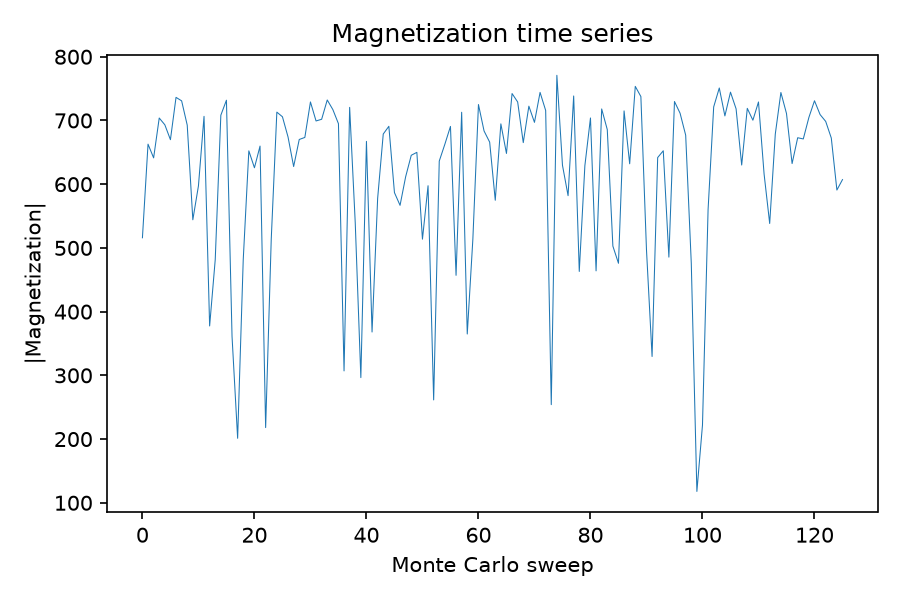
The most direct way to check equilibration is to plot the time series of a measured observable. We load the magnetization time series from the output file and plot it:
files = pyalps.getResultFiles(prefix='parm1a')
ts_M = pyalps.loadTimeSeries(files[0], '|Magnetization|')

plt.plot(ts_M)
plt.xlabel('Monte Carlo sweep')
plt.ylabel('|Magnetization|')
plt.title('Magnetization time series')
plt.show()
Inspect the resulting plot: the observable should settle to a roughly stationary value after an initial transient.
If the time series is still drifting at the end of the run, or if it shows a clear trend in the early sweeps that extends well into the measurement phase, the thermalization period (THERMALIZATION) is too short and must be increased.
For the parameters above (THERMALIZATION=10000), the time series already fluctuates around a stable mean with no visible drift, indicating that thermalization was sufficient:
Automated check: pyalps.checkSteadyState
Rather than judging equilibration by eye, pyalps.checkSteadyState applies a statistical test to determine whether a time series has reached a stationary distribution.
It returns the data annotated with a flag indicating whether each observable has passed the test.
The default confidence level is 68.27% (one sigma); this can be raised:
data = pyalps.loadMeasurements(pyalps.getResultFiles(prefix='parm1a'), '|Magnetization|')

# Default: 68.27% confidence interval
data = pyalps.checkSteadyState(data)

# Stricter: 90% confidence interval
data = pyalps.checkSteadyState(data, confidenceInterval=0.9)
Convergence
Convergence is a separate question from equilibration: even after the system has fully equilibrated, the statistical errors in the measured averages decrease only as with the number of independent samples . A convergence check verifies that the simulation has accumulated enough measurements for the error estimates to be reliable and stable.
pyalps.checkConvergence tests whether the errors in the measured averages have stabilized.
It is used in the same way as checkSteadyState:
data = pyalps.loadMeasurements(pyalps.getResultFiles(prefix='parm1a'), '|Magnetization|')
data = pyalps.checkConvergence(data)
If the check fails, increase SWEEPS and rerun the simulation.
Questions
- Shorten the
THERMALIZATIONperiod significantly (e.g. to 100 sweeps). Can you see the initial transient in the time series? DoescheckSteadyStateflag it? - How does the required thermalization length change as you move away from the critical temperature? Try: and .
- Increase and decrease
SWEEPSby a factor of ten. How do the error bars on the magnetization change? Does this match the expected scaling? - Why is it important to check both equilibration and convergence? Can a simulation pass one check and fail the other?