跳至内容

Bosons in an Optical Lattice

Bandstructure of an homogeneous optical lattice

Theory

At this first moment, we shall look at the simplest case, i.e. a single particle of mass mm which experiences a periodic potential V(r)V(\vec{r}), where

V(r)=xα=x,y,zV0xαsin2(πxα) V(\vec{r}) = \sum_{x_\alpha = x,y,z} V_0^{x_\alpha} \sin^2 (\pi x_\alpha)

in the units of recoil energy Erα=22m(2πλα)2E_r^\alpha = \frac{\hbar^2}{2m} \left( \frac{2\pi}{\lambda_\alpha} \right)^2 and lattice spacing λα2\frac{\lambda_\alpha}{2}.

The quantum mechanical behaviour of the single particle follows

[1π2(i+2πk)2+xα=x,y,zV0xαsin2(πxα)]uk(r)=ϵkuk(r) \left[\frac{1}{\pi^2} \left( -i \nabla + 2\pi \vec{k} \right)^2 + \sum_{x_\alpha = x,y,z} V_0^{x_\alpha} \sin^2 (\pi x_\alpha)\right] u_k (\vec{r}) = \epsilon_k u_k(\vec{r})

which is clearly separable to say the xx-component:

[1π2(ix+2πkx)2+V0xsin2(πx)]ukx(x)=ϵkxukx(x), \left[\frac{1}{\pi^2} \left( -i \partial_x + 2\pi k_x \right)^2 + V_0^{x} \sin^2 (\pi x)\right] u_{k_x} (x) = \epsilon_{k_x} u_{k_x}(x),

where kx=0,1Lx,Lx1Lxk_x = 0, \frac{1}{L_x} ,\cdots \frac{L_x-1}{L_x}.

In the plane wave basis,

ukx(x)=1LxmZcm(kx)ei2mπx u_{k_x} (x) = \frac{1}{\sqrt{L_x}} \sum_{m \in \mathbf{Z}} c_m^{(k_x)} e^{i2m\pi x}

We arrive at a tridiagonal diagonalization problem:

[4(m+kx)2+V0x2]cm(kx)V0x4cm1(kx)V0x4cm+1(kx)=ϵkxcm(kx). \left[ 4(m + k_x)^2 + \frac{V_0^x}{2} \right] c_m^{(k_x)} - \frac{V_0^x}{4} c_{m-1}^{(k_x)} - \frac{V_0^x}{4} c_{m+1}^{(k_x)} = \epsilon_{k_x} c_m^{(k_x)}.

The wannier function is defined as:

w(x)=1Lxkxukx(x)ei2πkxx=1LxkxmZcm(kx)ei2π(m+kx)x, w(x) = \frac{1}{\sqrt{L_x}} \sum_{k_x} u_{k_x} (x) e^{i 2\pi k_x x} = \frac{1}{L_x} \sum_{k_x} \sum_{m \in \mathbf{Z}} c_m^{(k_x)} e^{i 2\pi (m+k_x) x},

and from there, one can calculate the onsite interaction:

U=gw(x)4dx=4πas2mw(x)4dx. U = g \int | w(x) |^4 dx = \frac{4 \pi a_s \hbar^2}{m} \int | w(x) |^4 dx.

After a little bit of algebra, we arrive at the hopping strength:

t=1Lxkxϵkxei2πkx. t = -\frac{1}{L_x} \sum_{k_x} \epsilon_{k_x} e^{-i2\pi k_x}.

Finally, the Fourier transform of the wannier function is:

w~(qx)=1Lxw(x)ei2πqxxdx=1LxkxmZcm(kx)δqx,kx+m. \tilde{w}(q_x) = \frac{1}{\sqrt{L_x}} \int w(x) e^{-i2\pi q_x x} dx = \frac{1}{\sqrt{L_x}} \sum_{k_x} \sum_{m \in \mathbf{Z}} c_m^{(k_x)} \delta_{q_x, k_x+m}.

Implementation in Python

An example

For instance:

import numpy;
import pyalps.dwa;

V0   = numpy.array([8. , 8. , 8.]);      # in recoil energies
wlen = numpy.array([843., 843., 843.]);  # in nanometer
a    = 114.8;                            # s-wave scattering length in bohr radius
m    = 86.99;                            # mass in atomic mass unit
L    = 200;                              # lattice size (along 1 direction)

band = pyalps.dwa.bandstructure(V0, wlen, a, m, L);

A first glance of the band structure:

>>> band

Optical lattice: 
================
V0    [Er] = 8    8    8    
lamda [nm] = 843    843    843    
Er2nK      = 154.89    154.89    154.89    
L          = 200 
g          = 5.68473

Band structure:
===============
t [nK] : 4.77051    4.77051    4.77051    
U [nK] : 38.7018
U/t    : 8.11272    8.11272    8.11272    

wk2[0 ,0 ,0 ] : 5.81884e-08
wk2[pi,pi,pi] : 1.39558e-08

Well, the values of t(nK)t(nK), U(nK)U(nK), and U/tU/t can be obtained via:

>>> numpy.array(band.t())
array([ 4.77050984,  4.77050984,  4.77050984])
>>>
>>> numpy.array(band.U())
array(38.7018197381118)
>>>
>>> numpy.array(band.Ut())
array([ 8.11272192,  8.11272192,  8.11272192])

In momentum (q\vec{q}) space, the (squared) wannier function w~(q)2|\tilde{w}(\vec{q})|^2 can be obtained in the xx-direction from:

>>> numpy.array(band.q(0))
array([-5.   , -4.995, -4.99 , ...,  5.985,  5.99 ,  5.995])
>>> 
>>> numpy.array(band.wk2(0))
array([  7.57249518e-15,   7.88189086e-15,   8.20434507e-15, ...,
     1.62988573e-18,   1.56057426e-18,   1.49429285e-18])

and the yy- or zz- direction by replacing the index 0 to 1 and 2 respectively.

Bosons in an optical lattice trap

Boson Hubbard model

Hamiltonian

Bosons in an optical lattice trap can be effectively described by the single band boson Hubbard model

H^=ti,jb^i+b^j+U2in^i(n^i1)i(μVT(ri))n^i \hat{H} = -t \sum_{\langle i,j \rangle} \hat{b}_i^+ \hat{b}_j + \frac{U}{2} \sum_i \hat{n}_i (\hat{n}_i - 1) - \sum_i ( \mu - V_T ( \vec{r}_i) ) \hat{n}_i

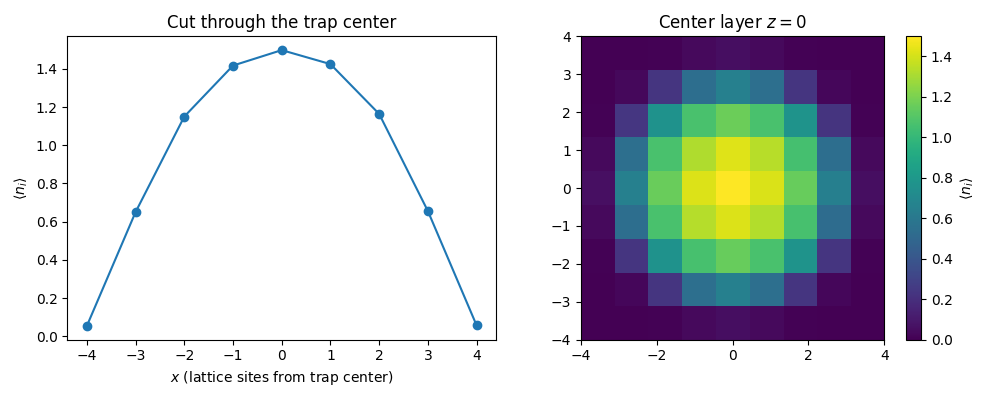
with hopping strength tt, onsite interaction strength UU, and chemical potential μ\mu at finite temperature TT via Quantum Monte Carlo implemented in the directed worm algorithm. Here, b^\hat{b} (b^+\hat{b}^+) is the annihilation (creation) operator, and n^i\hat{n}_i being the number operator at site ii. Bosons in an optical lattice are confined, say in a 3D parabolic trapping potential, i.e.

VT(ri)=Kxxi2+Kyyi2+Kzzi2, V_T (\vec{r}_i) = K_x x_i^2 + K_y y_i^2 + K_z z_i^2,

due to the gaussian beam waists as well as other sources of trapping.

Finite temperature

At finite temperature TT, the physics is essentially captured by the partition function

Z=Trexp(βH^) Z = \mathrm{Tr} \, \exp \left(-\beta \hat{H} \right)

and physical quantities such as the local density

ni=1ZTrn^iexp(βH^)=1ZCni(C)Z(C) \langle n_i \rangle = \frac{1}{Z} \mathrm{Tr} \hat{n}_i \exp \left(-\beta \hat{H} \right) = \frac{1}{Z} \sum_{\mathcal{C}} n_i (\mathcal{C}) Z(\mathcal{C})

for some configuration C\mathcal{C} in the complete configuration space, with inverse temperature β=1/T\beta = 1/T . Here, the units will be cleverly normalized later on.

Contributors

  • Ping Nang Ma
  • Matthias Troyer